Macarena Bruner de Lebrija
La piel del tamborMacarena Bruner de Lebrija, duchess of Nuevo Extremo and heir to one of Spain’s oldest aristocratic families, stands at the intersection of private injury and inherited history. The press presents her as a society scandal; the Archbishop sees her as a possible obstacle to a church redevelopment; but her own account gives her resistance a different center: she is defending a family memory, a threatened church, and the right to decide what the past means.
Identity and Position
Macarena is the wife, or possibly estranged wife, of Pencho Gavira, the ambitious vice-president and director general of Banco Cartujano. Their marriage had once been arranged with the help of Octavio Machuca, the banker who had sponsored Gavira’s rise. Machuca had held Macarena at the cathedral baptismal font and later led her, dressed in white satin, to the altar, where she married his protégé. The match joined her family’s wealth and position to Gavira’s prospects, and gave him the social endorsement he needed as a rising young lawyer.
That public alliance has become unstable. A blurred telephoto photograph on the cover of Q+S shows Macarena leaving the Alfonso XIII hotel at four in the morning with the bullfighter Curro Maestral. Gavira is humiliated by the image, and Machuca remarks on Maestral, but the novel makes clear that the photograph is not the central danger for Gavira. His position at the bank is more seriously threatened by the church redevelopment scheme and Macarena’s support for its parish priest, Príamo Ferro. The gossip about her marriage and the struggle over Nuestra Señora de las Lágrimas thus converge: her private separation has become entangled with a contest over property, authority, and Gavira’s succession to Machuca.
The Church and the Marriage Conflict
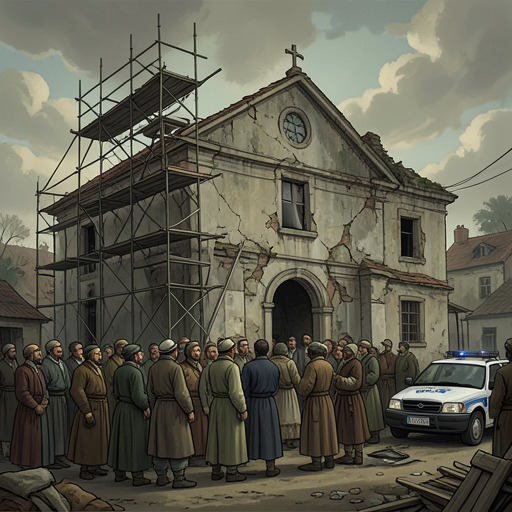
The redevelopment plan for Nuestra Señora de las Lágrimas is vulnerable to an old Bruner family privilege, documented in 1687. The privilege imposed conditions on the land donated for the church; if they were not met, the property could revert to the Bruner family. A later nineteenth-century law connected with Mendizábal’s confiscation of church property complicated the issue, providing for the land to pass to the municipality of Seville if it was secularized. A lawsuit brought by the duchess and her daughter could delay the project, which was already burdened by investments and commitments.
The Archbishop therefore approaches the family as a possible means of restraining Ferro. He suggests that Lorenzo Quart speak with Macarena and her mother, the old duchess, in the hope that they might withdraw their support while the church’s ruin assessment and the priest’s suspension remain pending. Yet Macarena is already openly on Ferro’s side. Her involvement is not presented simply as religious devotion: the Archbishop himself doubts that description, while acknowledging the scandal her conduct has caused among Sevillian society. The distinction matters. Her commitment to the church is bound up with family inheritance and personal conviction, not merely conformity to institutional expectations.
Macarena explains that her battle is her own, not Ferro’s. She describes herself as belonging to an extinguishing caste and says that the world has little place left for people like her family, or for the memories they carry. She means to defend her space, fulfill her obligations to her name and to the things she loves, and accept the end only after fighting to the last. She specifically names Nuestra Señora de las Lágrimas and the memory of Carlota as part of that obligation. The church’s threatened future is therefore inseparable from the threatened continuity of her family’s story.
Carlota Bruner and the Stolen Letters
Macarena tells Quart that Carlota Bruner was her great-great-aunt and loved Manuel Xaloc, a sailor without a fortune. After Xaloc emigrated to America, Carlota wrote to him almost weekly for years. Her father, Macarena’s great-grandfather Luis Bruner, wanted to stop the correspondence and bribed local postal officials. For six years, Carlota received no letters; the family believes Xaloc received none either. When he returned to find her, Carlota had lost her reason. She spent her days at a window looking toward the river and could no longer recognize him.
The letters preserve the distance between the facts Macarena recounts and the hope Carlota continued to inhabit. In one, Carlota suspects that her family is interfering with Xaloc’s mail, yet insists that a small inner certainty tells her her own messages are not lost. She imagines the white sails coming upriver with him and waits in a tower, sitting in a rocking chair during the silent heat of the afternoon. Her perceptions begin to blur: she thinks the galleons painted in the stairway pictures are moving, and interprets dreams of children on a beach as favorable signs. The tenderness of this imagined future sharpens the cruelty of the actual separation: the correspondence was not answered because it had been obstructed, and the reunion came too late for recognition.
For Macarena, Carlota’s story is not a picturesque family legend detached from the present. It is evidence of what can be destroyed when family authority controls a woman’s choices and communication. Her own defense of the Bruner inheritance and the church places memory in public space, resisting the erasure that turned Carlota’s years of waiting into an almost private family tragedy. The correspondence gives that resistance a material form: letters existed, were written repeatedly, and were prevented from reaching their intended reader.
A Missed Encounter and the Inheritance of Time
Machuca’s recollection offers another story of love lost through convention. He remembers seeing a beautiful woman pass the same café terrace long ago. Their eyes met; he thought he should rise and stop her, but the conventions of his position and his reputation in Seville held him back. He told himself he would see her again. She never passed that way again. He recounts the episode without visible emotion, as an objective fact, and tells Gavira that age has made even battles that should have been his seem to belong to someone else.
The episode forms a quiet counterpoint to Carlota’s letters. Machuca’s lost possibility comes from a moment of hesitation; Carlota and Xaloc’s separation is sustained over years by deliberate interference. In both histories, what cannot be recovered is not only a person but the future that might have followed a different act. Macarena’s defense of memory answers that loss with deliberate action. Her old family name, the church, and Carlota’s story are not simply remnants she admires; they are the things she chooses to protect while she still can.
Marriage, Pressure, and Personal Cost
The strains between Macarena and Gavira extend beyond the public photograph and the redevelopment dispute. Macarena tells Quart that she became pregnant, and that Gavira reacted as though the world had fallen in on him. He insisted that it was too soon and that there were already too many problems. She says that he pressured her more intensely than anyone ever had, urging her to end the pregnancy. Quart recognizes that she did so. The scene makes their marital conflict concrete: political ambition and practical anxieties entered her body as pressure, leaving the decision part of the intimate history she discloses to him.
This account complicates the public image of a duchess whose late-night appearance with a bullfighter supplies an easy scandal. The novel instead reveals a woman negotiating the costs of a marriage shaped by social strategy, the demands of a powerful husband, and a future she could not preserve. Her support for Ferro and her resistance to the church’s redevelopment carry the same refusal to surrender all control to the men and institutions around her. The narrative does not reduce her to a symbol of aristocratic decline: she recognizes that her inherited world is disappearing, yet acts within that knowledge rather than mistaking preservation for certainty of victory.
Narrative Significance
Macarena’s character joins several forms of memory that the novel keeps in tension: the record of a land privilege, the suppressed correspondence of Carlota and Xaloc, the public gossip surrounding her marriage, and the private disclosure of an unwanted pressure to terminate a pregnancy. These are not interchangeable kinds of evidence. Legal documents can make a claim on land; letters can reveal a love that was hidden from its recipient; a magazine photograph can expose a marriage to public judgment; and a confession can disclose what appearances leave out.
Her own description of the struggle as a battle against time and oblivion supplies its governing image. Macarena knows that her caste is fading and does not claim that memory can restore what has vanished. Instead, she treats fidelity to the family name, the church, and Carlota’s story as a last stand: the meaning lies in defending what she loves before accepting an ending. That choice makes her both an adversary to Gavira’s ambitions and a custodian of a past that cannot be made whole again.